About Us
Programs
Faculty
Calendar
Employment


THE GORIN PHILOSOPHY

The Gorin School of Music prides itself in teaching music comprehensively. Following the European tradition, individual instrumental skill training is combined with history and theory study, solfeggio, and ear training, Students learn not only the facts of music, but also the skills of being able to write down what hey hear and sing what they have learned to play on their instrument. The GSM Program produces in students an internalization of the logic, richness, and subtleties of music, leading to a fuller understanding and appreciation in both playing and listening to music that they will carry them for the rest of their lives.


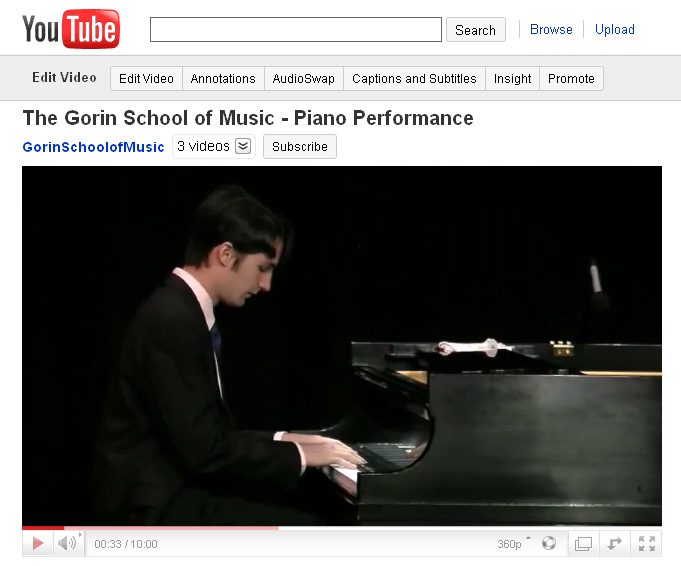
GSM takes great pride in the way it prepares its students to become capable musicians, culminating in the Graduation Recital, where GSM graduates demonstrate their accomplishment by performing music expressively and confidently.

20% of GSM graduates become music majors in college, another 20% continue music education as music minors, and 55% continue by playing in community orchestras, churches, bands, etc. The GSM drop out rate is a mere 5%.

The GSM Curriculum with its system of learning and accountability enables the students to move progressively from level to level and successfully graduate.


GOALS

•To develop knowledge, understanding, appreciation and love for music
•To develop performing skills on the chosen instrument
•To learn music theory, literature, solfeggio, and composition (for students who show special interest).

THE GORIN PHILOSOPHY
GOALS
TUITION
ACTIVITIES
Individual Lessons
Group Lessons
Evaluations and Recitals
For Very Young Children
For Adults
For College Music Majors and Music Professionals


ACTIVITIES
Individual Lessons
Individual lessons are available in piano, violin, viola, cello, guitar, flute, clarinet,
saxophone, accordian and voice. GSM instructors, distinguished performers and
teachers from the United States, Russia, Asia, and other European countries bring
a wealth of experience to their students. They provide each student with a foundation
in the physical demands of his or her instrument, the basics of reading music, and the
technical and interpretive skills of performance.

Group Lessons
The Comprehensive Musicianship course provides students with an intimate knowledge of the
inner workings of music, Weekly classes cover music theory (harmony and form analysis),
ear training, solfege, rhythmic training, and music history. The fourth class meeting of each month
is set aside for chamber music and creative activities. Membership in the GSM choir is included

Evaluations and Recitals
GSM students are evaluated twice each year by a jury of the faculty to
assess their progress on the chosen instrument. Comprehensive
Musicianship students are also evaluated twice a year. This formal
evaluation motivates students to work hard and provides valuable
feedback on their growing proficiency. Students are also encouraged
to participate in the GSM festivals held twice each year. Newer performers
can build their confidence in "Let's Share Music" workshops, which provide
a relaxed, informal environment for their first performances. All of these
events are held in GSM's own Bach Auditorium.

Achievement-minded students are encouraged to participate in
the many outside programs available: the MTAC Certificate of
Merit Evaluations and Branch Recitals, the National Guild program,
MTNA recitals and competitions, and GSM's own community outreach
concerts. Competitions such as the Junior Bach Festival and the US
Open Competition among others can provide additional opportunities
for honing performing skills.

For Very Young Children
GSM has a special preparatory music program for children ages 4 to 7, which allows children to explore music and share musical experiences with other children in the relaxing atmosphere of games. The program provides children
with experience in notation, singing, solfege, ear and rhythm training, and prepares them for the future study of the individual instruments. The program is divided into 3-month sessions, One session includes 12 classes, 4 classes per month. The tution for one session (12 classes) is $260.00. It will take place on Thursdays 4:45-5:30 p.m. To register, please call the school at (650) 961-4910 and leave a message.

For Adults
All individual instruction and comprehensive musicianship instruction is available to adult students.
It is never too late to learn.

For College Music Majors and Music Professionals
Advanced Piano Study for college music majors and professional musicians who would like to learn more about Russian technique using various methods of the European master-teachers such as Czerny, Leschetizky, Matthay, Neuhause, Lhevinne, etc., and helping them get ready for evaluations and competitions. Classes are taught by Mrs. Rufina Gorin and
Dr. Namik Sultanov.
Advanced Music Theory & Analysis and Compositions classes are designed for college music majors, and cover advanced musical analysis through form, harmony, counterpoint, critical analyses. Classes are taught by Ilya Dimov.
Piano with focus in Improvisation, Jazz and Composition is a class offered to college students, as well as piano teacher (MTAC) who would like to integrate music improvisation in their teaching or study. The improvisation classes are taught by Patric Nikolas.

TUITION

Tuition for private instructions:

$31.00 per 30 minute lesson (available only for students taking lessons twice a week)
$46.50 per 45 minute lesson
$62.00 per 60 minute lesson
Theory package* $80.00 per month (per student taking instrumental or voice lessons at GSM)
*Weekly theory, solfege, ear training, history, and chamber music, plus semi-monthly choir

Certificate of Merit and National Guild Auditions fees are charged separately by their respective administering organizations.

Accompaniment fees: $19.00 (30 min)
Recital / Evaluation fees: $17.00
Registration fees: $22.00 (due at the time of registration)
Consulting-evaluation fee: $45.00 (30 min) or $90.00 (an hour)

Programs and Tuition
GSM Policy